A WhatsApp ad tracker is software that attributes paid ad clicks to the WhatsApp conversation and the purchase that follows it. FlowTracker is a WhatsApp ad tracker. It captures click identity and UTM detail, matches the same person through the first WhatsApp message to the sale, and reports revenue per ad.
A WhatsApp ad tracker is attribution software for funnels that close in a chat rather than on a checkout page. It records who clicked which ad, binds that person to the WhatsApp thread they open, and then joins whatever happens in that thread, the qualification, the payment link, the order, back to the ad, adset and campaign that started it.
There are two distinct routes into WhatsApp from paid media, and they fail in different ways:
Most advertisers run both. A tracker that only handles the first route will silently under-report the second, and the missing revenue will look like poor performance rather than missing data.
Someone taps your ad. If it points at a landing page, the browser loads it and the pixel fires with the platform click identifier in the URL. Meta writes it into a first-party cookie called _fbc, in the documented format fb.subdomain_index.creation_time.fbclid.
Then they tap your WhatsApp button. The operating system opens WhatsApp. Your pixel is not running there, your cookies are not readable there, and the conversation that follows is invisible to the ad platform. The sale is closed in the chat, or on a payment link sent through it, and the platform never hears about it.
Because the platform sees clicks and no purchases, it bids toward people who click. Your reported cost per lead looks fine while your actual cost per customer drifts, and the campaigns being scaled are the ones that generate conversations rather than the ones that generate money.
WhatsApp is a Meta property, so Meta provides more here than it does for any other messaging app. For click to WhatsApp ad formats it mints its own click identifier and makes it available for server-side matching:
"ctwa_clid. Do not hash. Click ID generated by Meta for ads that click to WhatsApp."
Meta, Conversions API, Customer Information Parameters. developers.facebook.com, checked 14 August 2026.That identifier only exists on the click to WhatsApp route. If your ad sends people to a landing page first, which is the normal pattern when you need to qualify, present an offer or comply with a policy, there is no ctwa_clid anywhere in the flow. The only identity available is the platform click identifier that arrived on the landing page, and it has to be captured and carried across deliberately.
Meta also accepts a conversion source that names this exact situation. The Conversions API documentation defines business_messaging as a conversion "made from ads that click to Messenger, Instagram or WhatsApp", and chat as one "made via a messaging app, SMS, or online messaging feature". The reporting path exists. What is missing in most stacks is the thing that fills it in.
FlowTracker captures the click identity and full UTM detail on landing, matches the same person through the Telegram join or WhatsApp message and then the purchase, and sends every matched step both back to the originating ad platform and into your own database, so you read which ad, adset and campaign produced revenue without relying on the platform to attribute it.
For a WhatsApp funnel specifically:
Stated with its scope: FlowTracker reports a 97.2 percent match rate on traffic that arrives through a tracked link. A person who saves your number from a poster, or is forwarded your link privately, has no click record to match, and that is a limit of physics rather than of software.
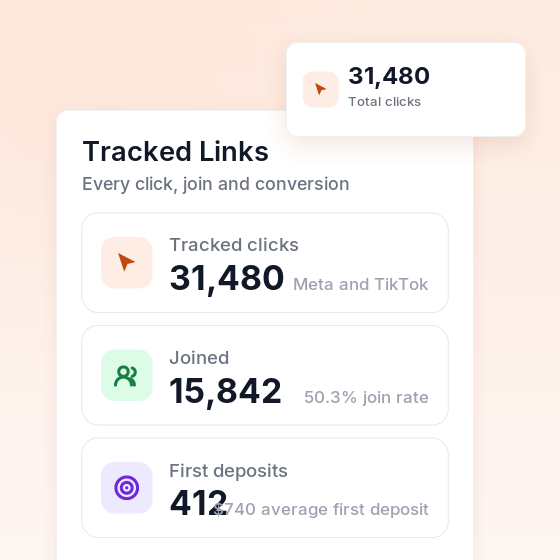
One tracked link per ad, creative or placement, pointed at your WhatsApp number. Build one with the free WhatsApp link generator.
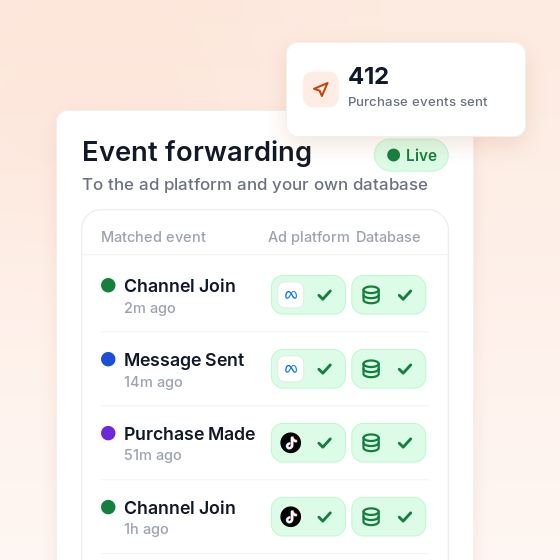
WhatsApp, Instagram, Messenger, Telegram and Live Chat land in a single queue with the source ad beside each thread. See the omnichannel inbox.
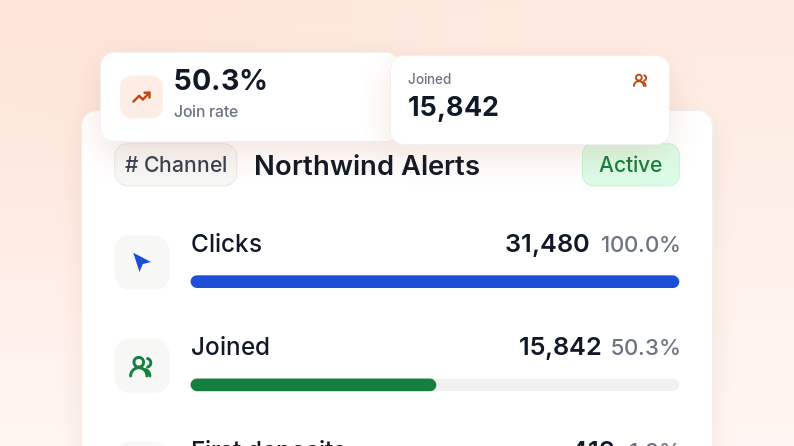
Matched purchases are returned through the official Conversions APIs. See the WhatsApp integration and Meta Ads integration.
The gap is rarely the number of conversations. It is whether any system can name the ad that produced the one that paid.
| Can it do this? | Meta pixel only | wa.me link with a prefilled text | Shared WhatsApp inbox tool | FlowTracker |
|---|---|---|---|---|
| Report ad clicks | Yes | Yes | No | Yes |
| Report WhatsApp conversations started | No | Count only | Yes | Yes |
| Say which ad produced a specific conversation | No | Crudely | No | Yes |
| Work on the click to WhatsApp ad route | No | No | Varies | Yes |
| Work on the ad to landing page to WhatsApp route | No | Crudely | No | Yes |
| Attribute a purchase closed inside the chat | No | No | No | Yes |
| Send the conversion back to Meta or TikTok | Pixel only | No | No | Yes |
| Keep the raw record in your own database | No | No | Partial | Yes |
Primary vendor documentation only. Each link was checked on 14 August 2026. FlowTracker publishes no customer counts, ratings or review scores, because it has none to publish.
A WhatsApp ad tracker is software that attributes paid ad clicks to the WhatsApp conversation they produce and to the sale that follows. It exists because WhatsApp is a separate application with no advertising pixel of yours running inside it, so an ordinary web tracker loses the person the moment the chat opens.
Because the conversion happens outside the browser. A click on your ad opens WhatsApp, and from that point there is no tab, no cookie and no pixel. If the sale is then closed in the chat, or on a payment link, nothing automatically tells the ad platform which ad produced it. The platform sees a click and no outcome.
It is a click identifier Meta generates for ads that click to WhatsApp. Meta's Conversions API documentation describes ctwa_clid as the click ID generated by Meta for ads that click to WhatsApp, and lists it as a user_data parameter that must not be hashed. It is produced by click to WhatsApp ad formats, not by ads routed through a landing page.
Yes, and that route needs different handling. There is no Meta-issued WhatsApp click identifier in that case, so the tracker has to capture the platform click identifier on the landing page, store it server side, and bind it to the WhatsApp thread when the first message arrives. FlowTracker supports both routes.
Yes. Meta's Conversions API accepts an action_source of business_messaging, documented as a conversion made from ads that click to Messenger, Instagram or WhatsApp, and chat for conversions made via a messaging app. FlowTracker sends matched purchases through the official Conversions API with the stored click identity attached.
You need a WhatsApp Business account connected to FlowTracker so that inbound messages can be read and matched. Once connected, the first message on a thread is what binds the person to their stored ad click, and every later message, payment link and purchase stays attached to that same lead.
Yes, on WhatsApp and Telegram, subject to the per channel consent stored on each contact. FlowTracker does not send email, SMS or voice campaigns. Broadcast audiences can be filtered by the campaign that produced each contact, and results are reported as conversions and revenue rather than as opens.
FlowTracker reports a 97.2 percent match rate on traffic that arrives through a tracked link. Someone who saves your number from a poster, or is forwarded your link by a friend, has no click record to match against, and no tool can create one. No attribution system reaches 100 percent and FlowTracker does not claim to.
No. WhatsApp and your ad accounts connect with OAuth, tracked links and QR codes are generated in the dashboard, and no code goes on your website. Most teams have a tracked WhatsApp link live in about five minutes and see their first attributed conversations the same day.
Track is free. Operate is 499 dollars per month, Perform is 999 dollars per month and Scale is 1,999 dollars per month. Every paid plan starts with a 7 day free trial and no credit card is required to start. Plans scale with contacts and events rather than with seats.
The same problem on the other big messaging app, and how the join is matched back to the ad.
Read more → GuidesMessage categories, templates and per-country rates, so the cost side is not a surprise.
Read more → ProductWhatsApp and Telegram broadcasts to consent-based segments, measured in revenue rather than opens.
Read more →Every claim on this page is set out at length somewhere below, with Meta's own documentation quoted in full.
Where it appears in the referral object, how to return it unhashed, when it is missing, and what Meta does not document about it.
Read more → AttributionOnly WhatsApp issues a click ID. Messenger and Instagram give you ref, ad_id and a scoped user ID. A field-by-field comparison.
Read more → AttributionThe pixel is JavaScript reading cookies on your domain, and the person left the browser. The documented chain, step by step.
Read more → AttributionMeta's 7 day event_time cutoff, Google's 90 and 63 day limits, TikTok's 28 days, and the difference from an attribution window.
Read more → GuidesTwenty-nine terms defined from primary vendor documentation, each with a source and a check date.
Read more → Free ToolPaste a payload and check it against the 7 day rule, the documented action source values and Meta's hashing rules, in your browser.
Read more →Connect WhatsApp and your ad accounts, put a tracked link behind your campaigns, and watch conversations get attributed.