A Meta to Telegram ad tracker connects a Facebook or Instagram ad click to what the same person does inside Telegram, and back again. FlowTracker does this: it captures the Meta click identity on landing, matches the Telegram join and the purchase to it, and sends the conversion back to Meta.
Meta to Telegram is the hardest common variant of chat attribution, because the two systems have no shared identifier and no commercial reason to build one. Meta will tell you which of its users clicked. Telegram will tell you which of its users joined. Nothing in either platform connects the two, and neither company is going to fix that for you.
Meta solved this problem for itself. For click to WhatsApp ads it mints a dedicated click identifier and exposes it for server-side matching. Its Conversions API documentation lists it plainly among the accepted user data parameters:
"ctwa_clid. Do not hash. Click ID generated by Meta for ads that click to WhatsApp."
Meta, Conversions API, Customer Information Parameters. developers.facebook.com, checked 14 August 2026.There is no ctta_clid. There is no Telegram entry in that list at all, and there will not be one, because Telegram is a competitor rather than a Meta surface. Meta Ads Manager offers Messenger, Instagram and WhatsApp as messaging destinations. Telegram is reached the way any external site is reached, through a URL in a traffic or conversions campaign.
That leaves exactly one place where the two worlds touch: a page you control, sitting between the ad and the Telegram link. Everything a Meta to Telegram ad tracker does is built on that single point of contact.
A person taps your Facebook or Instagram ad. Meta appends its click identifier to the destination URL as fbclid. If that destination is a raw t.me link, the operating system opens Telegram and the identifier goes nowhere. It was never written to a cookie, never stored on a server, never seen by anything you own.
Telegram then receives a new member with no context whatsoever. Your channel grows. Your ad account reports clicks. Nothing anywhere records that this member and that click are the same person, and nothing ever can, because the only moment the two facts existed together has passed.
Days later that member buys, deposits or subscribes. Meta never hears about it. The campaign that produced your best customers looks identical, in Ads Manager, to the campaign that produced nobody. That is not a reporting inconvenience, it is the reason budget goes to the wrong place.
Even a perfectly matched conversion can be refused if it arrives late. Meta's Conversions API applies a hard cutoff, and it rejects the entire request rather than the individual stale event:
"The event_time can be up to 7 days before you send an event to Facebook. If any event_time in data is greater than 7 days in the past, we return an error for the entire request and process no events."
Meta, Conversions API, Server Event Parameters. developers.facebook.com, checked 14 August 2026.Telegram funnels are slow by nature. People join, lurk, read for a week and then buy. The conversion event has to be sent at the moment it happens, carrying the click identity captured days earlier, rather than reconstructed later from a report. That is a design constraint, not a setting.
FlowTracker captures the click identity and full UTM detail on landing, matches the same person through the Telegram join or WhatsApp message and then the purchase, and sends every matched step both back to the originating ad platform and into your own database, so you read which ad, adset and campaign produced revenue without relying on the platform to attribute it.
On the Meta to Telegram path, that is four concrete steps:
Stated with its scope, because it matters: FlowTracker reports a 97.2 percent match rate on traffic that arrives through a tracked link. Members who arrive by forwarded message, screenshot or channel search have no stored click and cannot be matched by any tool. FlowTracker does not claim guaranteed or complete attribution.
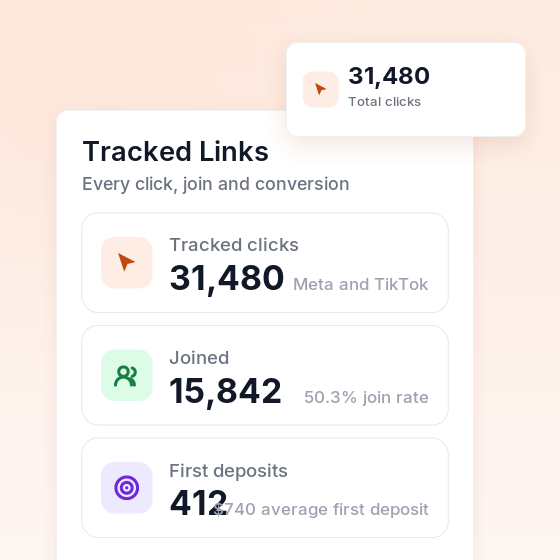
Ad accounts, campaigns, adsets and ads are read directly, so spend sits beside attributed revenue. See the Meta Ads integration.
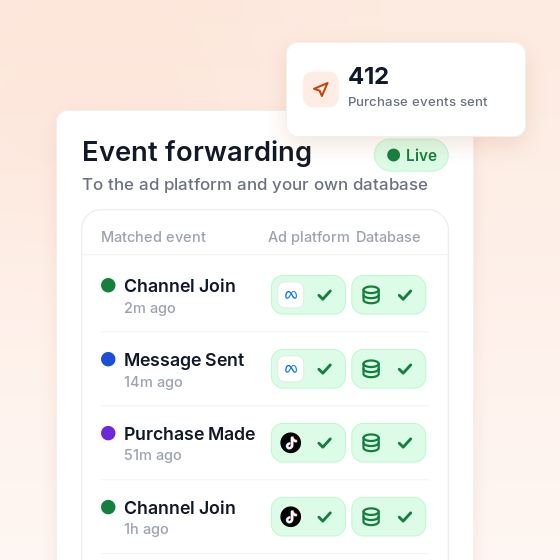
Bot funnels and personal-account funnels are both supported. See the Telegram bot integration and tracked links.
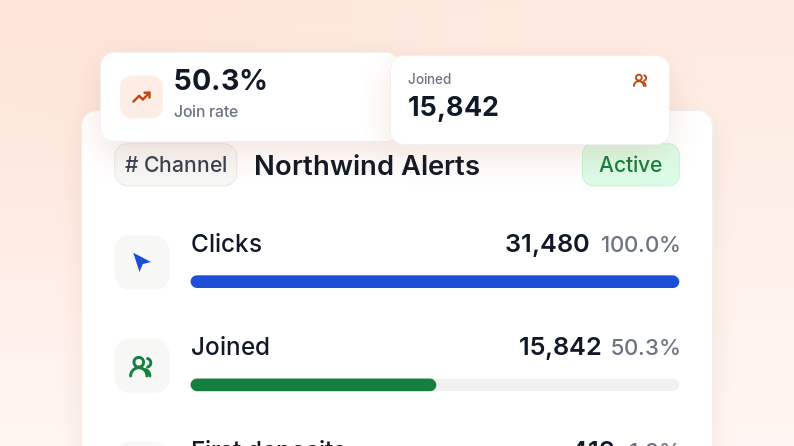
Matched events are returned to Meta with the click identity attached. Read what the Conversions API is and how deduplication works.
Only one of them leaves anything behind that can be matched later. The others are not cheaper, they are just quieter about what they lose.
| Does this route do it? | Ad to raw t.me link | Ad to page, manual UTM report | Meta click to WhatsApp ad | Ad to tracked link, then Telegram |
|---|---|---|---|---|
| Meta issues a click identifier | Yes | Yes | Yes | Yes |
| That identifier is stored somewhere you control | No | Partial | Meta side | Yes |
| Identity survives into Telegram | No | No | WhatsApp only | Yes |
| A specific join is tied to a specific ad | No | No | No | Yes |
| A sale days later is tied to that same ad | No | No | No | Yes |
| Conversion returned to Meta within the 7 day window | No | No | If instrumented | Yes |
| Works for channels as well as bots | No | No | No | Yes |
| Record kept in your own database | No | Manual | No | Yes |
Primary vendor documentation only. Each link was checked on 14 August 2026. FlowTracker publishes no customer counts, ratings or review scores, because it has none to publish.
A Meta to Telegram ad tracker connects a Facebook or Instagram ad click to what the same person does inside Telegram, and then sends the resulting conversion back to Meta. It is a narrower job than general attribution, because Telegram is not a Meta surface and Meta provides no identifier that crosses into it.
Because Meta issues a click identifier for its own messaging surfaces and not for anyone else's. Its Conversions API documentation lists ctwa_clid, the click ID generated by Meta for ads that click to WhatsApp. There is no equivalent for Telegram. A Meta to Telegram funnel has to carry the identity itself.
The ad points at a page you control. That page reads the fbclid query parameter and the _fbc cookie, stores them server side against a short reference, and forwards the visitor to your Telegram link with that reference attached. Telegram's Bot API allows up to 64 characters in the start parameter, which is enough for a lookup key.
Not as a native destination. Meta Ads Manager offers Messenger, Instagram and WhatsApp as messaging destinations, not Telegram. A Meta to Telegram funnel is built as a traffic or conversions campaign pointing at a URL. That URL should be a page you control rather than a raw t.me link, or the click identity is lost immediately.
The matched conversion, sent through the official Conversions API with the stored click identity attached. Meta's documentation defines a chat action_source as a conversion made via a messaging app, so the event can be reported honestly for what it is rather than disguised as a website purchase.
Then the identity is carried by a per-visitor invite link instead of the start parameter. Each visitor is issued their own single-use invite link, bound to their stored click record, so the join event is attributed to the ad that produced it. FlowTracker supports both routes and they can run side by side.
Yes, and it catches people out. Meta's Conversions API states that event_time can be up to 7 days before you send an event, and that a request containing any event older than that is rejected in full, with no events processed. Late conversions have to be sent promptly against their stored click, not backdated.
FlowTracker reports a 97.2 percent match rate on traffic that arrives through a tracked link. Someone who reaches your Telegram funnel through a forwarded message, a screenshot or a search for the channel name has no stored click, so no tool can match them. Attribution is never complete and FlowTracker does not claim otherwise.
No. The Meta ad account connects with OAuth, Telegram connects with a bot token you generate in Telegram, and the redirect page and tracked links are generated in the dashboard. Most teams have the full path live in about five minutes and see their first attributed joins the same day.
Track is free. Operate is 499 dollars per month, Perform is 999 dollars per month and Scale is 1,999 dollars per month. Every paid plan starts with a 7 day free trial and no credit card is required to start. Plans scale with contacts and events rather than with seats.
The general case: any paid source into Telegram, matched to joins, conversations and sales.
Read more → WhatsAppThe Meta-native route, where ctwa_clid exists and the landing page route still needs work.
Read more → ForexThe most common commercial use of a Meta to Telegram funnel: ad click to broker first-time deposit.
Read more →The Meta side and the Telegram side of this funnel, documented separately and in full.
The pixel is JavaScript reading cookies on your domain, and the person left the browser. The documented chain, step by step.
Read more → TelegramThe documented character limit and permitted alphabet, the 48 byte payload ceiling, and why a Meta click identifier cannot pass through it.
Read more → TelegramChatMemberUpdated field by field, per-visitor invite links, join requests, and the joins that carry no attribution at all.
Read more → AttributionOnly WhatsApp issues a click ID. Messenger and Instagram give you ref, ad_id and a scoped user ID. A field-by-field comparison.
Read more → AttributionMeta's 7 day event_time cutoff, Google's 90 and 63 day limits, TikTok's 28 days, and the difference from an attribution window.
Read more → Free ToolPaste a payload and check it against the 7 day rule, the documented action source values and Meta's hashing rules, in your browser.
Read more →Connect your Meta ad account and your Telegram bot or channel, and see the join, the sale and the campaign on one record.